
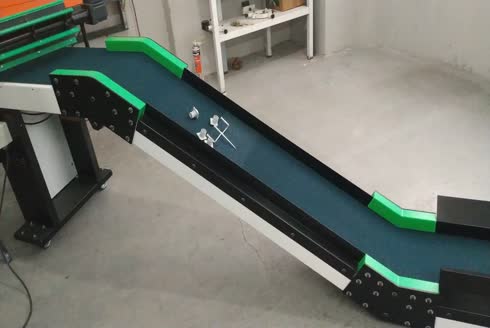
Plastic Injection L Conveyor Systems

What is a Conveyor System?
A conveyor system is a mechanical transport system that enables the automatic or semi-automatic movement of products, materials, or loads from one point to another. It is commonly used in factories, warehouses, logistics centers, airports, mining, food, and production lines.
The main purpose is:
- To reduce human labor
- To increase transport speed
- To ensure production continuity
- To enhance work safety
- To reduce costs
The Basic Working Principle of the Conveyor System
A motor generates motion → power is transmitted → belt/roll/chain moves → product is transported.
Simple flow:
[Motor] → [Reducer] → [Drive Drum] → [Belt] → Product Transport
Main Components of the Conveyor System
1. Motor ⚙️
Provides motion to the system.
Function:
- To convert electrical energy into mechanical energy
- To rotate the belt
Symbol:
2. Reducer 🔩
Reduces the motor speed and increases torque.
Symbol:
- M = Motor
- R = Reducer
3. Drive Drum ⭕
The main drum that moves the belt.
Symbol:
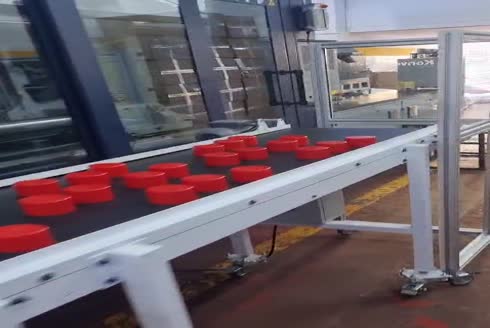
4. Conveyor Belt 🟩
The moving surface on which the product is transported.
Symbol:
Material:
- PVC
- Rubber
- Polyurethane
- Wire mesh
5. Rollers ⚪
Ensures the smooth movement of the belt.
Symbol:
6. Chassis (Body) 🏗️
The metal structure that carries the entire system.
Generally:
- Steel
- Stainless steel
- Aluminum profile
7. Tension Mechanism 🔧
Prevents the belt from loosening.
Symbol:
8. Sensors 📡
Provides product detection and automation control.
Types:
- Photoelectric sensor
- Inductive sensor
- Capacitive sensor
Simple Conveyor System Diagram
 PRODUCT FLOW DIRECTION →
────────────────────────────────
[S] [S]
| |
O=================================O
| |
| |
[M]-[R] Tension
────────────────────────────────
Explanation:
- O = Drum
- M = Motor
- R = Reducer
- S = Sensor
Types of Conveyors
1. Belt Conveyor
The most common system.
Usage:
- Package transport
- Cargo
- Food
- Factory lines
2. Roller Conveyor
The product moves on rollers.
Advantage:
- Low energy consumption
3. Chain Conveyor
Used for heavy load transport.
Usage:
- Automotive
- Palette transport
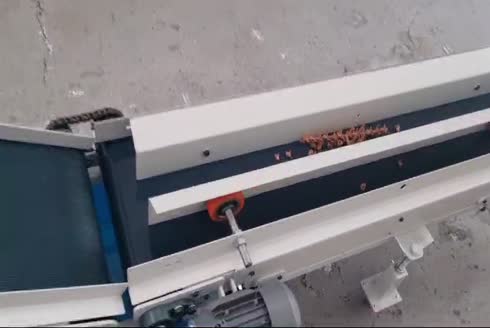
4. Screw (Helical) Conveyor
Transports powder or granule materials.
Usage:
- Cement
- Flour
- Feed factories
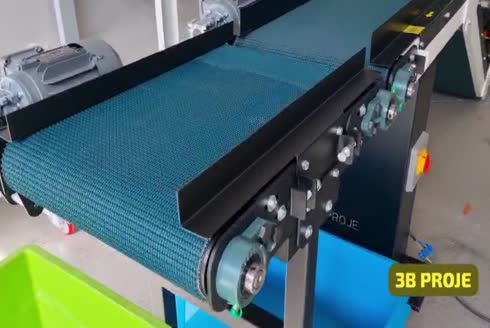
5. Modular Conveyor
Consists of segmented plastic belts.
Advantage:
- Easy maintenance
- Hygienic structure
Automation in Conveyor Systems
In modern systems:
Sensor → PLC → Motor Driver → Conveyor
Equipment used:
- PLC
- Inverter
- Servo motor
- HMI screen
- RFID reader
Example of PLC Control Logic
Scenario:
- When the sensor detects a product, the belt operates.
Simple logic:
IF Sensor = ON
THEN Motor = RUN
Electrical control symbol:
[S] ----(M)
Advantages of Conveyor Systems
✅ Provides continuous transport
✅ Reduces labor costs
✅ Ensures fast production
✅ Reduces error rates
✅ Ensures work safety
✅ Suitable for automation
Disadvantages
❌ Initial investment cost can be high
❌ Requires maintenance
❌ In case of failure, the line may stop
❌ Incorrect capacity selection reduces efficiency
Areas of Use
Industrial Use
- Factories
- Automotive
- Food production
- Pharmaceutical industry
Logistics
- Cargo centers
- Warehouses
- Airport baggage systems
Mining
- Coal
- Stone
- Ore transport
Basic Formulas in Conveyor Calculations
Belt Speed
v=πDn60v=\frac{\pi D n}{60}v=60πDn
- vvv = Belt speed (m/s)
- DDD = Drum diameter
- nnn = Revolutions per minute
Power Calculation
- PPP = Power
- FFF = Force
- vvv = Speed
Conveyor Safety Equipment
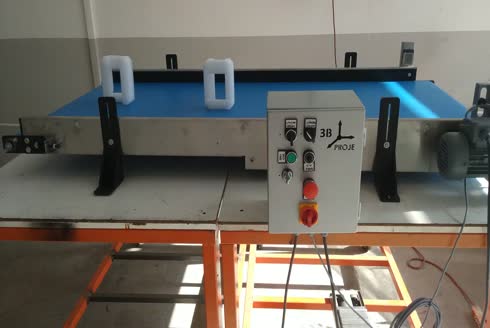
Emergency Stop System ⛔
[EMERGENCY STOP]
Protective Covers
- Drum protection
- Chain enclosure
- Sensor safety area
A Typical Line in Industry
Loading
↓
Conveyor-1
↓
Sensor
↓
Separator System
↓
Conveyor-2
↓
Packaging
↓
Shipping
Conclusion
Conveyor systems are one of the essential transport infrastructures of modern industry. A well-designed system:
- increases production speed,
- ensures work safety,
- provides energy efficiency,
- works fully integrated with automation.





 Brokerless Trade without Commission
 All Communication Channels
 Available on mobile phones
 Open a Store and Post an Ad